
Rust Tickler 3 - Huntress CTF 2025 Reverse Engineering Writeup
Complete walkthrough of Rust Tickler 3, a multi-stage Rust reverse engineering challenge from Huntress CTF 2025. Covers dynamic analysis, memory extraction, custom PRNG XOR cipher, and AES-256-CBC decryption techniques.
- tags
- #Reverse-Engineering #Ctf #Rust #Huntress #Cryptography #Ida #Procmon
- categories
- CTF Writeups Reverse Engineering
- published
- reading time
- 14 minutes
Description
Challenge Author: @Nordgaren
Challenge Prompt: It’s back. Good luck.
Category: Reverse Engineering
CTF: Huntress 2025
Solution
Stage 1: rust-tickler-3.exe
Initial Analysis
The challenge provides a Rust binary for analysis. Opening the binary in IDA Free and decompiling it reveals the typical Rust structure with a main function. Upon dynamic execution of the binary, the user is presented with the following prompt:
What is my favorite sha256 hash?
Since this binary expects user input that needs to be validated for some activity, the analysis focuses on identifying where user input gets validated by examining the overall code structure and setting strategic breakpoints on potentially relevant code patterns.
Validation Function
To find the validation routine, breakpoints are placed on interesting code patterns in the disassembled view of IDA Free, particularly on if statements and function calls that could be involved in validation logic. Executing the binary in IDA’s built-in debugger and stepping through the code flow reveals the following sequence:
- The first several
ifstatements are reached before user input is even collected, ruling them out as the validation check - After providing test input and continuing execution, a breakpoint is hit at a significant
ifstatement
This critical if statement contains the validation logic (note that functions have been renamed for better readability):
if ( xor_prng_validate_input(args1, (__int64)args2, args3) )
  {
    may_msg_print(&v62, (__int64)&args1_prt, 4921);
    if ( (_QWORD)v62 == 0x8000000000000000uLL )
      goto LABEL_113;
    hObject.m256i_i64[2] = (__int64)p_p_hObject;
    *(_OWORD *)hObject.m256i_i8 = v62;
    p_hObject = &hObject;
    v57 = (__int64)sub_11D0;
    *(_QWORD *)&v62 = &unk_240A478;
    *((_QWORD *)&v62 + 1) = 2;
    v65 = 0;
The validation occurs through a call to xor_prng_validate_input at BASE+23EDDF0. The function receives three arguments in the following registers:
- First argument (RSI / args1): Pointer to a structure containing encrypted data
- Second argument (R13 / args2): Pointer to the user’s input
- Third argument (RDX / args3): Length of the input
The xor_prng_validate_input function implements a custom stream cipher using a PRNG-like algorithm:
bool __fastcall xor_prng_validate_input(__int64 a1, __int64 a2, __int64 a3)
{
  unsigned int v3; // seed (from struct)
  __int64 v4 = 0;
  if ( *(_QWORD *)(a1 + 16) != a3 )
    return 0;
  v3 = *(_DWORD *)(a1 + 24);
  do
  {
    if (a3 == v4) break;
    uint32_t v6 = v3 * ((__ROR4__(v3, v3) & 0xFFFFFFFC) + 1) + (__ROL4__(~v3, 4) | 1);
    uint32_t v7 = v6 >> ((v3 >> (~(_BYTE)v3 & 0xF)) % 0x18);
    v3 = v6;
    if ((*(_BYTE *)(a2 + v4) ^ (unsigned __int8)v7) != *(_BYTE *)(*(_QWORD *)(a1 + 8) + v4))
      return false;
    ++v4;
  } while (1);
  return true;
}
The function operates by:
- Verifying the input length matches the expected length stored in the structure at offset
+16 - Extracting a seed value from the structure at offset
+24 - Generating a pseudo-random keystream using bitwise operations (ROR, ROL, XOR)
- XORing each input byte with the corresponding keystream byte
- Comparing the result against pre-encrypted data pointed to by offset
+8in the structure
To understand the data structure being used and where it comes from, the decompiled code before the validation call is examined. Tracing where args1 originates from reveals it comes from a lookup function just a few lines above the validation:
v1 = lookup_struct_entry_by_id(&args1_ptr, 4922);
if ( !v1 )
  goto LABEL_113;
args1 = v1;
args2 = utf8_skip_ws_and_return_ptr(v79, v80);
v5 = args3;
if ( (unsigned __int8)xor_prng_validate_input(args1, args2, args3) )
The args1 structure is retrieved by lookup_struct_entry_by_id, which takes a pointer to an array of structures (args1_ptr) and an index value (4922) used to identify the specific entry. Analyzing this lookup function reveals how the structure array is organized:
__int64 __fastcall lookup_struct_entry_by_id(__int64 struct_array_ptr, int search_id)
{
  __int64 current_entry_ptr;
  __int64 remaining_bytes;
  __int64 found_entry;
  bool id_matches;

  current_entry_ptr = *(_QWORD *)(struct_array_ptr + 8) - 40LL;
  remaining_bytes = 40LL * *(_QWORD *)(struct_array_ptr + 16);
  while ( remaining_bytes )
  {
    found_entry = current_entry_ptr + 40;
    remaining_bytes -= 40;
    id_matches = *(_DWORD *)(current_entry_ptr + 72) == search_id;
    current_entry_ptr += 40;
    if ( id_matches )
      return found_entry;
  }
  return 0;
}
This function searches through an array of 40-byte structures. The struct_array_ptr parameter points to a structure that contains the base address and count of entries in the array. The function iterates through these entries, comparing the ID field at offset +32 (shown by current_entry_ptr + 72 which equals current_entry_ptr + 40 + 32) until it finds the entry matching the search_id of 4922.
Dynamic Analysis
To extract the encrypted data and seed, a breakpoint is set at the call to xor_prng_validate_input in the IDA debugger. When the breakpoint is hit after providing test input, the register values reveal the function arguments:
- RSI (first argument / args1):
0x000001C283DB7878- pointer to the Entry structure - R13 (second argument / args2): pointer to user input
- RDX (third argument / args3): input length
Examining the memory at the Entry structure pointer (RSI) reveals the structure fields:
*(RSI + 0x8): pointer to encrypted buffer*(RSI + 0x10): buffer length (64 bytes)*(RSI + 0x18): seed value0x133A
Following the pointer at offset +0x8 to the encrypted buffer and dumping 64 bytes yields:
encrypted_hex = (
    'F5 40 C3 B7 2D EE C9 CE 88 F6 C1 56 48 14 59 0B '
    '6A 38 52 79 EF B6 33 7F EE C8 61 5E B7 DC 95 7F '
    '62 1B D9 87 9E C6 90 CD 3B F1 65 C2 56 E2 07 67 '
    'AB D0 EA 94 3E 1C F6 B6 2C 24 F2 23 E9 19 97 32'
)
Implementing the PRNG Algorithm
The PRNG algorithm must be replicated exactly as implemented in the binary to generate the correct keystream. Three helper functions are needed:
ror()- Performs a right bitwise rotation, shifting bits to the right with wraparoundrol()- Performs a left bitwise rotation, shifting bits to the left with wraparoundgenerate_stream()- Implements the custom PRNG algorithm using rotate operations and arithmetic to produce the keystream bytes
With the encrypted data, seed, and PRNG implementation, the complete decryption script can be written:
#!/usr/bin/env python3

def ror(value, count, bits=32):
    """Rotate right operation"""
    count %= bits
    return ((value >> count) | (value << (bits - count))) & ((1 << bits) - 1)

def rol(value, count, bits=32):
    """Rotate left operation"""
    count %= bits
    return ((value << count) | (value >> (bits - count))) & ((1 << bits) - 1)

def generate_stream(seed, length):
    """Generate PRNG keystream matching the binary's algorithm"""
    output = []
    for _ in range(length):
        ror_val = ror(seed, seed)
        v6 = seed * ((ror_val & 0xFFFFFFFC) + 1) + (rol(~seed & 0xFFFFFFFF, 4) | 1)
        shift_amount = (~seed & 0xF)
        shift = (seed >> shift_amount) % 0x18 if shift_amount < 32 else 0
        stream_byte = (v6 >> shift) & 0xFF
        output.append(stream_byte)
        seed = v6 & 0xFFFFFFFF  # Keep seed 32-bit
    return output

# Encrypted data extracted from memory
encrypted_hex = (
    'F5 40 C3 B7 2D EE C9 CE 88 F6 C1 56 48 14 59 0B '
    '6A 38 52 79 EF B6 33 7F EE C8 61 5E B7 DC 95 7F '
    '62 1B D9 87 9E C6 90 CD 3B F1 65 C2 56 E2 07 67 '
    'AB D0 EA 94 3E 1C F6 B6 2C 24 F2 23 E9 19 97 32'
)

encrypted = bytes.fromhex(encrypted_hex.replace(' ', ''))
seed = 0x133A

# Generate keystream
stream = generate_stream(seed, len(encrypted))

# Decrypt by XORing encrypted data with keystream
plaintext = bytes([b ^ s for b, s in zip(encrypted, stream)])
print(plaintext.decode('utf-8', errors='replace'))
Expected input:
a4ec6d39192922bdec0e310db3dda25f21f1d7e8e9e68cfebc156553e4123b03
Stage 2 extraction
Providing the correct input string prints the success message “Thank you, Bingus! But our princess is in another castle!” however there is no additional hint on how go get the flag. To understand the binary’s behavior after successful validation, Process Monitor (Procmon) from Sysinternals Suite is used to observe file system and registry activity during execution.
Running the binary under Procmon with the correct input reveals a suspicious entry:

Operation: CreateFile
Path: C:\Users\ladmin\AppData\Roaming\Exodus
Result: NAME NOT FOUND
Desired Access: Read Attributes, Synchronize
In Windows, when CreateFile is called with Desired Access: Read Attributes, Synchronize on a path without a file extension, this indicates a directory existence check rather than an attempt to open a file. The NAME NOT FOUND result means the program is checking for the Exodus directory, which does not exist.
This directory can be created manually in the expected APPDATA location. Running the binary again with the correct input now produces different behavior. Procmon shows successful file operations, and examining the Exodus directory reveals that a new file has been created:
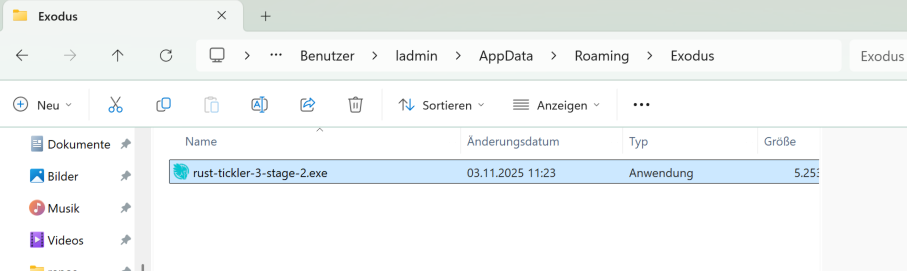
The file rust-tickler-3-stage-2.exe appears in the directory. Based on the dynamic analysis and the appearance of the second stage, it can be deduced that the second-stage binary is embedded in encrypted form within the first stage. After successful input validation and directory verification, the program decrypts this embedded data and writes the resulting executable to disk. The second stage binary does not execute automatically and must be run manually to continue the challenge.
Stage 2: rust-tickler-3-stage-2.exe
Initial Analysis
The second stage binary rust-tickler-3-stage-2.exe is opened in IDA Free for decompilation and analysis. Following a similar methodology to Stage 1, the analysis begins by locating the main function and examining the overall code structure. An initial execution without breakpoints confirms the executable prompts for user input “Okay for real this time, the flag is actually going to be the password. I definitely not in the icon file…”, indicating another validation challenge.
To locate the validation logic, breakpoints are set on interesting code sections, particularly conditional statements and function calls that could be involved in input verification. After providing test input and continuing execution through the debugger, two critical functions are discovered that handle the cryptographic validation process.
Identifying the Validation Functions
Through dynamic execution with breakpoints the validation logic is traced to a function at BASE+1CC0, renamed to compare_function for clarity. This function acts as a wrapper that extracts parameters from two structures and passes them to the actual validation routine at BASE+1E30, renamed to validate_and_check.
Analysis of validate_and_check reveals it encrypts the user’s input using AES-256-CBC and compares the result against pre-computed expected ciphertext stored in memory. The validation succeeds only if the encrypted input matches the expected ciphertext exactly, block by block.
The compare_function
void compare_function(undefined8 *param_1, undefined4 *param_2)
{
  validate_and_check(
      param_1 + 6,                      // scratch_ctx
      *param_1,                         // expected_ciphertext_ptr
      param_1[1],                       // expected_padded_len (48)
      param_1[2],                       // key_ptr
      *(undefined4 *)(param_1 + 3),     // key_len (32)
      param_1[4],                       // iv_ptr
      *(undefined4 *)(param_1 + 5),     // iv_len (16)
      *param_2,                         // user_input_ptr
      param_2[2]);                      // user_input_len
  return;
}
This function acts as a wrapper, extracting fields from two parameter structures:
param_1: A structure containing cryptographic material and validation parametersparam_2: A structure containing the user’s input and its length
By analyzing the memory dump at param_1 (RCX register) during dynamic analysis, the structure layout is determined as follows:
// Structure 1 - Cryptographic Material (verified via memory dump)
param_1[0] -> expected_ciphertext_ptr  (48 bytes of AES ciphertext)
param_1[1] -> expected_padded_len      (48 bytes input length after PKCS#7 padding)
param_1[2] -> key_ptr                  (32 byte AES-256 key)
param_1[3] -> key_len                  (32 bytes)
param_1[4] -> iv_ptr                   (16 byte initialization vector)
param_1[5] -> iv_len                   (16 bytes)
param_1[6] -> scratch_ctx              (Context buffer for encryption operations)

// Structure 2 - User Input
param_2[0] -> user_input_ptr           (Pointer to users input string)
param_2[2] -> user_input_len           (Length of users input)
The validate_and_check Function
This function implements the cryptographic validation using AES-256-CBC. Before any encryption occurs, it performs input length validation:
(Note: The following code snippet contains only the relevant portions necessary for understanding the validation logic, not the complete function implementation)
__int64 __fastcall validate_and_check(
        __int64 *scratch_ctx,
        __int64 expected_ciphertext_ptr,      // Pointer to expected ciphertext
        size_t expected_padded_len,           // Expected length after padding (48)
        __int64 key_ptr,                      // Pointer to AES-256 key
        unsigned __int64 key_len,             // Key length (32 bytes)
        __int64 iv_ptr,                       // Pointer to IV
        unsigned __int64 iv_len,              // IV length (16 bytes)
        __int64 user_input_ptr,               // Pointer to users input
        size_t user_input_len)                // Length of users input
{
  block_size = get_divisor_value(scratch_ctx);
  if ( !block_size )
    goto LABEL_ERROR;
  // Calculate expected padded length from user input
  calculated_padded_len = block_size + user_input_len - (user_input_len % block_size);
  if ( expected_padded_len != calculated_padded_len )
    goto LABEL_ERROR;
  // Initialize crypto context with key and IV
  initialize_crypto_ctx__(
      (DWORD *)expected_encrypted_chunk,
      *scratch_ctx,
      0,
      key_ptr,
      key_len,
      iv_ptr,
      iv_len);

  // Encryption loop - process input in blocks
  for (block_offset = 0; block_offset < expected_padded_len; block_offset += block_size)
  {
    // Encrypt current block of user input
    encrypt_buffer_evp(&v23, &v21, user_input_ptr, block_offset,
                       (__int64)expected_encrypted_chunk, 2 * block_size);

    // Compare encrypted block against expected ciphertext
    if ( memcmp(expected_encrypted_chunk, (const void *)(user_input_ptr + v18), value_16) )
      break;
  }
}
The validation function operates as follows:
- Length Validation: Calculates the expected padded length from the user’s input
- Context Initialization: Sets up the AES-256-CBC encryption context using the 32-byte key and 16-byte IV
- Block-by-block Encryption: Encrypts the user’s input one 16-byte AES block at a time
- Comparison: After encrypting each block, compares it against the corresponding block of expected ciphertext stored in memory
- Success Condition: All three encrypted blocks must match the expected ciphertext for validation to succeed
To recover the expected input, the expected ciphertext can be extracted from memory and decrypted using the key and IV, directly revealing the expected input.
Dynamic Analysis
To extract the cryptographic material (AES key, IV, and expected ciphertext), two breakpoints are placed in the IDA debugger within the validation flow.
Breakpoint 1: initialize_crypto_ctx__
A breakpoint at the call to initialize_crypto_ctx__ (BASE+2300) captures the cryptographic parameters being initialized.
- First 4 arguments:
RCX,RDX,R8,R9
Register values at breakpoint:
RCX: 0x30                      ; arg1: Buffer size (48 bytes)
RDX: 0x6                       ; arg2: Algorithm identifier (AES-256)
R8:  0x30                      ; arg3: Key material length (48 bytes)
R9:  0x00007FF7285FD128        ; arg4: Pointer to key+IV material
Examining the memory at R9 (address 0x7FF7285FD128) and dumping 48 bytes reveals the cryptographic material:
00007FF7285FD128: D4 C3 94 86 FD F0 42 83  F5 D9 64 36 BA 68 EA 1C
00007FF7285FD138: 4F 41 94 79 6A F8 2D 0F  8E ED 7C 12 F5 3F A0 7C
00007FF7285FD148: 53 9F B3 1E 1C C1 34 42  42 0D 03 93 97 E9 17 77
Since the total length is 48 bytes and AES-256 requires a 32-byte key and 16-byte IV, the data can be split as follows:
Extracted cryptographic material:
-
AES-256 Key (bytes 0-31):
D4 C3 94 86 FD F0 42 83 F5 D9 64 36 BA 68 EA 1C 4F 41 94 79 6A F8 2D 0F 8E ED 7C 12 F5 3F A0 7C -
Initialization Vector (IV) (bytes 32-47):
53 9F B3 1E 1C C1 34 42 42 0D 03 93 97 E9 17 77
Breakpoint 2: memcmp - Extracting Expected Ciphertext
A breakpoint at the memcmp (BASE+2031) call reveals where encrypted blocks are compared against the expected ciphertext. This function is called once per AES block (16 bytes), so multiple hits are expected as the program validates each block.
x64 calling convention for memcmp:
RCX: Pointer to first buffer (the encrypted user input)RDX: Pointer to second buffer (expected ciphertext)R8: Number of bytes to compare
Register values at breakpoint:
RCX: 0x0000001B6078F980    ; The encrypted input block
RDX: 0x00007FF7285FD0F8    ; Expected ciphertext block 1
R8:  0x10                  ; 16 bytes (one AES block)
The value at RCX shows what the test input was encrypted to (not needed). The essential data is at RDX the expected ciphertext address.
Since the expected input is 38 bytes and AES operates on 16-byte blocks, the total encrypted size with PKCS#7 padding is 48 bytes (3 blocks). Dumping 48 bytes from the ciphertext address reveals the complete expected ciphertext:
00007FF7285FD0F8: CB 58 4B 62 03 5D 13 8F  77 BC 98 10 F0 0F 1A 20
00007FF7285FD108: 20 70 0F 8F BF 0D 75 DC  A3 FD 71 08 5F 14 67 CD
00007FF7285FD118: E9 D0 5F 1F 83 BB C7 6B  7D 9B EB 42 F7 51 00 95
Complete expected ciphertext (48 bytes):
Block 1 (0-15):   CB 58 4B 62 03 5D 13 8F 77 BC 98 10 F0 0F 1A 20
Block 2 (16-31):  20 70 0F 8F BF 0D 75 DC A3 FD 71 08 5F 14 67 CD
Block 3 (32-47):  E9 D0 5F 1F 83 BB C7 6B 7D 9B EB 42 F7 51 00 95
Decryption Script
With all the cryptographic material extracted (AES-256 key, IV, and expected ciphertext), the solution involves decrypting the expected ciphertext using the extracted key and IV, which directly reveals the flag.
#!/usr/bin/env python3
from Crypto.Cipher import AES

# Expected ciphertext extracted from memory at 0x7FF7285FD0F8
# Captured from the memcmp breakpoint - this is what the encrypted
# input is compared against
ciphertext = bytes.fromhex(
    'CB584B62035D138F77BC9810F00F1A20'  # Block 1
    '20700F8FBF0D75DCA3FD71085F1467CD'  # Block 2
    'E9D05F1F83BBC76B7D9BEB42F7510095'  # Block 3
)

# AES-256 Key extracted from initialize_crypto_ctx__ call
# Found in R9 register (0x7FF7285FD128), bytes 0-31
key = bytes.fromhex(
    'D4C39486FDF04283F5D96436BA68EA1C'
    '4F4194796AF82D0F8EED7C12F53FA07C'
)

# IV (Initialization Vector) extracted from initialize_crypto_ctx__ call
# Found in R9 register (0x7FF7285FD148), bytes 32-47
iv = bytes.fromhex(
    '539FB31E1CC13442420D039397E91777'
)

print("[*] Crypto material extracted from memory:")
print(f"    Key:        {key.hex()}")
print(f"    IV:         {iv.hex()}")
print(f"    Ciphertext: {ciphertext.hex()}")
print()

# Decrypt using AES-256-CBC
cipher = AES.new(key, AES.MODE_CBC, iv)
plaintext = cipher.decrypt(ciphertext)

# The answer is 38 bytes, rest is PKCS#7 padding (0x0A repeated 10 times)
answer = plaintext[:38].decode('ascii')
print(f"[+] {answer}")
Output:
[*] Crypto material extracted from memory:
    Key:        d4c39486fdf04283f5d96436ba68ea1c4f4194796af82d0f8eed7c12f53fa07c
    IV:         539fb31e1cc13442420d039397e91777
    Ciphertext: cb584b62035d138f77bc9810f00f1a2020700f8fbf0d75dca3fd71085f1467cde9d05f1f83bbc76b7d9beb42f7510095

[+] flag{fb8de641f383151222845d9b991a17c2}